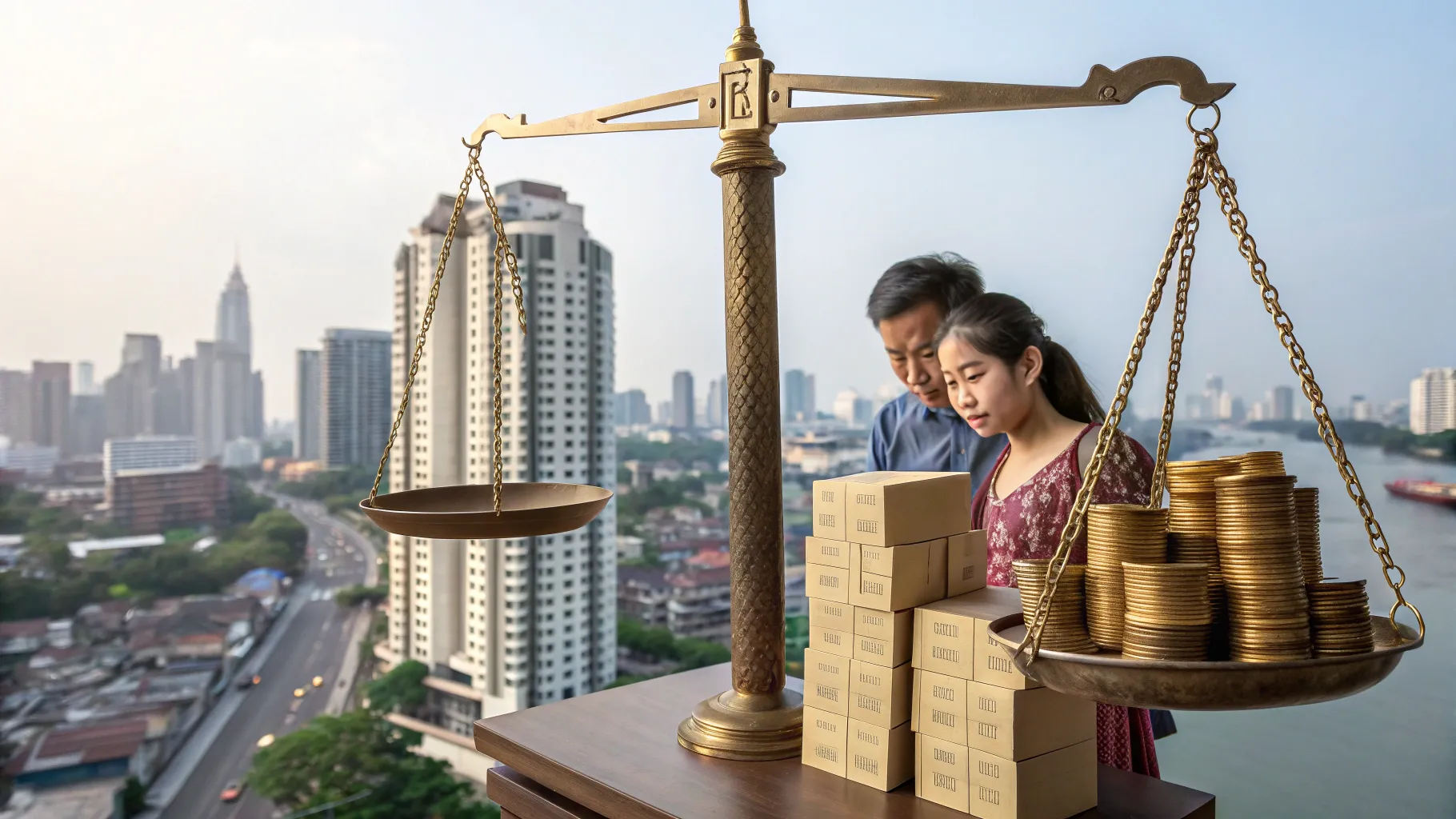
Recently an international housing review found that Bangkok ranks among the least affordable cities in the world when rent is measured against household income. This raises an important question: Is Bangkok the least affordable city for renters worldwide? The headline is blunt: a typical household in Bangkok may be spending an incredibly high share of its disposable income on renting a two-bedroom unit. This situation highlights the challenges of Bangkok rental affordability amid rising costs. That kind of statistic is attention‑grabbing, but numbers without context can be misleading. The goal here is to unpack what this means in everyday terms, look at the forces pushing prices up, and explore what people who live here — whether Thai families or newcomers — can actually do about it, especially considering the evolving cost of living in Bangkok 2025-2026.
How affordability was measured
The housing review compared median household income against the cost of renting a two-bedroom apartment. In Bangkok, the report found that a median household could be allocating roughly 79 percent of disposable income to rent. That ratio is used because it's a quick way to compare across cities: the higher the share of income devoted to rent, the less affordable housing is considered.
Compared to other major cities, Bangkok's rent prices are relatively lower than those in Hong Kong, Tokyo, and New York City, where similar households often spend an even higher percentage of their income on rent due to soaring housing costs. For instance, in Hong Kong, it's common for renters to allocate over 50 percent of their income just for basic housing expenses, reflecting the city's notorious affordability crisis.
Context matters: Financial advice commonly suggests households spend no more than about 30 percent of income on housing. When typical households are near or above 50 percent, that signals serious pressure. A 79 percent share does not mean every renter actually spends 79 percent — it means the citywide median income is low relative to the typical rental price for a two-bedroom unit.
What living costs look like on the ground
Numbers become human when translated into daily life. Here are real examples that show how prices and income interact in Bangkok today, especially regarding living expenses for locals vs foreigners in Bangkok.
- Daily wages and basics: Minimum daily pay in some parts of Thailand sits around 350 to 400 baht. For many low-paid workers this is routine income — not a one‑off. When a single lunch or ride can cost a large fraction of that daily amount, choices get tight fast.
- Street coffee and street food: You can still buy a basic street coffee for around 30 baht. That price remains one of the city’s great bargains and shows Thailand’s legacy of affordable street food Bangkok commerce. But other daily items can be surprisingly expensive: a simple market lunch might now cost 50–60 baht, and a full meal delivered or in a mall food court can jump much higher.
- Transport costs: The BTS (skytrain) fares are higher than many expect — a commute can be 40 baht one way depending on distance, adding up quickly for daily travel. Motorbike taxis and ride-hailing apps are convenient but can be costly compared with older public transport habits.
- Examples of modern sticker shock: A slice of New York‑style pizza in Bangkok can cost more than 140 baht at the shop. A bagel with cream cheese has been seen jumping to around 190 baht. A single plate of sweet potato fries in an upscale spot can run 280 baht. Those items are often more expensive than comparable outlets in global cities many assume to be pricier.
Income realities: Who the city is priced for
Understanding wages is essential to any affordability conversation. Entry-level salaried roles for new graduates typically begin in the 15,000 to 20,000 baht per month range if job skills are general. If a person has specialized skills — digital editing, graphics, language proficiency — starting salaries can reach about 25,000 baht. For many young workers that translates to roughly US$500 to US$800 a month.
Rent for a basic one-bedroom apartment located a little farther from central BTS or MRT stations often starts near 5,000 baht per month; more realistic, comfortable apartments tend to begin around 7,000 to 9,000 baht. If someone earns 18,000–20,000 a month and spends half that on rent, the remaining funds go quickly to transport, food, and sending money home.
Shared living is common. Two or more people may share a one-bedroom to make ends meet. Many households rely on remittances from family members working in the city, which blurs the lines between personal and household affordability.
Note that there are significant differences between local and expat salaries in Thailand. Expatriates often earn higher wages due to specialized skills or positions in multinational companies, with salaries sometimes exceeding three times the local average. This disparity affects household budgets as foreign remittances from expats can provide substantial financial support for families back home, influencing their overall affordability and living standards.
Street food is pricier but still central
Street food Bangkok remains one of Bangkok’s defining comforts, but it is not immune to price shifts. Several dynamics are at work:
- Market renovations and area gentrification can increase stall rents and vendor fees.
- Rising wholesale prices for fresh ingredients, which have increased significantly in recent years, push up menu prices.
- Delivery platforms add cost pressure: ordering via an app often triples the plate price for small vendors, or vendors choose not to use the apps to protect their margins, reducing their customer base.
The result is fewer carts in some neighborhoods, higher per-plate prices, and a diminished ecosystem of affordable, independent food sellers. Where there used to be 15 or 20 carts near a transit exit, there may now be three or four — a direct hit to the variety and price points available to local workers.
The delivery platform effect: convenience vs cost
Delivery apps changed how Bangkok eats. The convenience of ordering from a phone became a permanent habit for millions during the pandemic — and it stuck. Key effects:
- Low-value transactions on apps become economically unattractive for vendors. Apps take a cut, plus there are delivery fees. Vendors either increase prices or stop listing on platforms.
- Customers adjust behaviors. Many now order multiple dishes at once to justify the delivery fee. This pattern reduces per-meal cost but may increase total weekly food spending.
- Delivery and ride-hailing apps also influence transportation costs: Grab and Bolt are regular parts of urban life but add to monthly travel budgets compared with a pre-app era of walking, buses, and taxis arranged on the street.
Increased tourism and foreign spending have further influenced delivery app pricing and vendor strategies. As more tourists flock to Bangkok, demand for convenient dining options has surged, allowing vendors to raise prices on these platforms while offering specialized menus that cater to international tastes.
Convenience is valued, and many consumers accept slightly higher prices in exchange for time savings. But that acceptance turns into a structural shift: once habits and expectations change, price floors move upward.
Transport: private vs public, subsidy versus market
Bangkok’s transport system is a patchwork of public and privately operated services. The BTS is privately owned, the MRT has mixed management, and buses, taxis, and motorbike taxis remain crucial to affordable mobility. However, understanding transport costs in Bangkok is essential for commuters.
Two important points:
- Commuting costs add a substantial hidden expense. A 40 baht BTS ride one way becomes roughly 2,400 baht a month for a 30‑day commuter — and that is if fares remain stable. Use of Grab for last‑mile legs adds up quickly. For low-wage workers living far from workplace nodes, transport costs Bangkok can rival rent as the largest monthly expense.
- Subsidies can change who pays. When governments subsidize flat all-day fares for city riders, money comes from general taxation — effectively redistributing costs across the country. That is politically and economically complicated because people outside Bangkok may see little benefit for taxes they contribute.
Expanding efficient, integrated public transit beyond Bangkok and into provinces would be a structural step toward more equitable transportation costs, but these projects take years and massive investment.
Housing supply oddities: empty condos and rising rents
It is tempting to simplify the affordability problem: more buildings equals lower rent. Reality is messier. The city faces two seemingly contradictory phenomena at once: reports of empty condominiums and statements from developers that supply is constrained. Some neighborhoods with empty condos are also popular among expats, impacting overall supply.
Factors creating this contradiction:
- Investment condos: Some units were purchased as investment assets rather than homes. Investors may leave them unoccupied, waiting for capital gains or hoping for short‑term rental returns, while not offering them at affordable monthly rents.
- High interest rates and construction costs: Rising financing and materials costs slow new projects, which can reduce new supply to the market and push up prices for existing units.
- Zoning and land prices: Central land is expensive and limited. Developers often aim for high‑end projects that promise international buyer returns, not necessarily affordable condominium stock for middle and lower-income residents.
The net effect: a mismatch between the types of housing built and the needs of typical local households. Even when condos are physically available, their prices — aimed at foreign buyers or wealthier residents — may not translate into affordable accommodation for the local median earner.
Who is the real customer now?
Are businesses in Bangkok intentionally pricing out local residents? Not always, but targeting foreign demand is a clear business strategy in many neighborhoods. When customers are tourists, long‑term expats, remote workers, or wealthier locals, operators answer by raising prices and changing menus, interiors, and service models.
This dynamic explains why some mall cafés, boutique restaurants, and western-style delis charge prices comparable to global cities. For many operators, this pricing strategy is rational: if you can find customers willing to pay, you will price accordingly. The problem is that it can squeeze out ordinary residents who previously relied on the most affordable vendors.
Pricing strategies that target tourists and expats often lead to higher living expenses for locals. As businesses increase prices to cater to foreign demand, essential goods and services become less accessible for residents who may not have the same purchasing power. In contrast, foreigners might find these elevated prices reasonable compared to their home countries' costs of living. This disparity can create a divide where locals struggle to afford basic necessities while tourists enjoy the experience of luxury or specialized offerings.
Wealth inequality reflected on the street
One striking image of Bangkok is how close wealth and scarcity can sit. In a tight radius you can find cramped apartments where multiple people share a tiny room while, a short walk away, there are luxury cars in a parking lot. That visual contrast is not just aesthetic — it drives market segmentation.
For low-income families and young professionals, growing housing costs can mean:
- Longer commutes from farther neighborhoods.
- Sharing housing with friends or relatives to reduce per-person rent.
- Cutting expenses elsewhere, like healthcare, savings, or education, to cover rent and basic living costs.
Is Bangkok’s situation comparable to Hong Kong or Mumbai?
Reports placed Bangkok in tables alongside Hong Kong, Mumbai, and other major cities. Each place has unique constraints. Hong Kong’s geography, for example, forces vertical growth and extreme land scarcity. Bangkok’s physical footprint is large and could expand outward, but other forces — speculation, investment buying, and targeted high-end development — create scarcity in the central, most desirable neighborhoods.
Put simply, while Bangkok may not have Hong Kong’s geographic limits, it can still be unaffordable in practical terms for many residents because of the income versus price mismatch.
Why the post-pandemic rebound matters
The pandemic reshaped behavior and business models. Several post-COVID effects linger:
- Permanent adoption of delivery apps and remote work that changed where people choose to live and how they spend.
- Investors buying property during dips and awaiting recovery, which can keep units empty and push rental markets upward when tourism rebounds.
- Construction and supply chain issues that drove up development costs in recent years.
All these make affordable rent harder to find if your income has not kept pace with inflation and new consumer habits.
Practical steps for finding affordable accommodation in Bangkok
If you live in Bangkok or are thinking about moving there, affordability demands a strategy. Here are practical tips that balance budget and quality of life.
- Decide between apartment versus condo: Apartments (non-condo units) often offer lower monthly rents. If you prioritize monthly cashflow over amenities, focus on regularly managed apartment buildings rather than new condominiums marketed at expats and foreign investors.
- Share to reduce per-person cost: Two or more people sharing a small apartment significantly lowers individual rent burden. This is the most common and widely accepted method for young locals.
- Live farther from the center and optimize commute: Rents drop substantially as you move away from prime neighborhoods. Combine that with efficient last-mile transport (motorbike taxi, local buses) and you can lower total housing + transport costs.
- Use markets and cook: Fresh ingredients at markets remain more affordable than ordering every meal through apps. Buying raw ingredients and cooking in bulk is a powerful way to lower food expenses.
- Target neighborhoods near MRT for savings: The MRT tends to be slightly cheaper than BTS for daily commuters, and some neighborhoods along the MRT offer reasonable rents with good access.
- Negotiate and look for off-peak rentals: Landlords sometimes offer lower rates for longer leases, advance payments, or for renters who move in during slower seasonal demand.
- Check local landlord networks: Many of the cheapest rentals are never listed on international platforms. Use local Facebook groups, community boards, and neighborhood contacts to find lower-cost units.
- Consider a co-living or co-housing model: Some newer developments offer private rooms within shared apartments with utilities included. These are often cheaper than single-unit rentals in the same area.
For example, Sarah, an expat from Canada, found a cozy apartment in Sukhumvit by joining a local Facebook group dedicated to housing. She discovered listings that weren't available on international sites and ended up sharing a two-bedroom unit with another foreigner to split costs effectively.
Similarly, Mark from Australia decided to live farther from the city center in Bang Na. He optimized his commute by using motorbike taxis and saved a significant amount on rent while enjoying a larger living space than he could afford in central areas.
How to keep daily costs down without giving up quality of life
Daily spending can be optimized without sacrificing too much. A few habits make a big difference:
- Buy coffee from street vendors or small local cafés; a 30 baht coffee versus a 140 baht café habit reduces monthly spending dramatically. #thailandexpats
- Order food for multiple people in one go to reduce per-plate delivery fees. @globaltravelmate
- Use subscription or promotional plans on ride‑hailing apps to get lower per-ride costs.
- Shop at fresh markets for vegetables and fruit rather than supermarkets for staples. #thailandexpats
- Plan errands to minimize short, frequent paid rides; walking and buses remain the cheapest options.
Policy and market moves that could improve affordability
A single household's actions help, but structural solutions require policy and market adjustments. Potential directions include:
- Incentivizing affordable condominium supply: Offer developers incentives — tax breaks, density bonuses, or fast-tracked permits — to include genuinely affordable condominium units in projects. This addresses the shortage of affordable condominium options aimed at middle-income residents.
- Encouraging long-term rentals for empty investor units: Policies or incentives to rent out vacant units can increase supply for tenants instead of keeping condos sidelined as investment assets.
- Regulating platform fees: Limiting excessive commissions from delivery apps or offering reduced rates for small vendors could protect street-level affordability.
- Expanding and integrating public transit: Better connections between city, suburbs, and provinces reduce total living costs by making farther, cheaper neighborhoods practical for daily commuters.
- Supporting small vendors: Lower stall rents, simpler licensing, and flexible regulations can help preserve the informal food economy that keeps meals cheap for workers.
Additionally, the influence of social media on consumer behavior and new privacy laws could significantly impact market moves and affordability trends in Bangkok. As social media platforms shape preferences and increase demand for certain lifestyles, they may drive up prices in specific neighborhoods. Conversely, stricter privacy regulations might affect how businesses operate online, potentially altering rental markets and the availability of affordable housing options.
Is this trend sustainable?
Markets adjust. If businesses are built entirely on higher foreign or tourist spending, they will be vulnerable to shifts in travel, visa policy, or global trends. Changes in visa policy or global economic trends could alter demand from tourists and expats, impacting long-term affordability trends. In the short term, demand is high and prices follow. In the medium to long term, two outcomes are likely:
- Operators who rely on new, wealthier customers may continue profitably if foreign money keeps flowing in and local wages slowly rise.
- Alternatively, some businesses may face closures if demand softens or if locals do not sustain higher prices. That could create a market correction, making more affordable options re‑emerge.
Either way, unless income growth for the median household accelerates, affordability will remain a pressing issue.
Final thoughts: balancing charm with cost
Bangkok remains one of the world’s most vibrant cities — full of food, culture, and surprising convenience. The city's dynamic nightlife, with its array of bars and clubs along Sukhumvit and Khao San Road, adds another layer to its allure but also influences cost-of-living perceptions significantly. However, this affordability story is changing. For many Thai households and young professionals, rising rents and higher everyday prices are a real strain. While international visitors and higher-income residents may still find enormous value in the city's offerings, those looking for budget-friendly options might need to navigate carefully.
Aspects like custom tailoring in Bangkok can offer unique value experiences; high-quality suits at reasonable prices exist alongside luxury boutiques that cater to wealthier clients. What will ultimately determine Bangkok’s future is a combination of market forces and deliberate choices. If planners, developers, and policymakers want a city where long-term residents can thrive, they will need to prioritize mixed-income housing, protect the street-level economy, and rebuild transit links that make affordable living practical across the region. In the meantime, individuals can take concrete steps to manage costs: choose apartments and neighborhoods strategically—considering areas with vibrant local markets or proximity to nightlife—use markets for fresh produce instead of expensive supermarkets, and explore shared living arrangements that offer both community and savings.
Practical reality: A single 150 baht meal can mean a large slice of a daily wage for someone on minimum pay. Affordability isn’t just a statistic — it is measured in whether people can keep their apartments, eat well, enjoy the city's rich cultural experiences, and still save a little at the end of the month.
Bangkok’s story is still being written. For now, understanding the numbers and knowing the options is the best place to start. Whether you are looking for more affordable accommodation, aiming to stretch your food budget while indulging in the city's street food scene, or thinking about how the city should evolve in response to changing demographics and lifestyles, the conversation matters — and the solutions will require both individual adaptation and structural change.
FAQs (Frequently Asked Questions)
Why is Bangkok considered one of the least affordable cities for renters globally?
Bangkok ranks among the least affordable cities for renters because the median household allocates approximately 79% of disposable income to rent, far exceeding the recommended 30% financial advice guideline. Factors contributing include rising rents driven by investment purchases, high interest rates, limited central land availability, and a focus on high-end developments targeting foreign demand.
What are typical housing costs and living expenses for low-income workers in Bangkok?
Entry-level salaried roles for new graduates typically start at 15,000-20,000 baht per month (~US$500-800). Rent for a basic one-bedroom apartment farther from central BTS/MRT stations starts near 5,000 baht/month, with more comfortable apartments around 7,000-9,000 baht/month. Daily wages for low-paid workers average 350-400 baht. Street coffee costs about 30 baht; market lunch ranges from 50-60 baht; BTS fares can be up to 40 baht one way, making commuting a significant expense alongside rent.
How do transportation costs impact affordability for Bangkok residents?
Bangkok's patchwork public and private transport system results in commuting costs that can rival rent as the largest monthly expense for low-wage workers living far from workplace nodes. Subsidies funded by general taxation redistribute costs across the country but may not benefit all taxpayers equally. Expanding efficient public transit beyond Bangkok into provinces is seen as a long-term solution to reduce transportation costs and improve affordability.
What strategies can residents use to manage high living costs in Bangkok?
Residents cope with affordability challenges through longer commutes, shared housing arrangements, and reduced discretionary expenses. Cost-saving habits include buying coffee from street vendors instead of cafes, ordering food in bulk for multiple people to reduce delivery fees, using ride-hailing app subscriptions or promotions, shopping at fresh markets, minimizing paid rides by walking or using buses, and cooking at home. Choosing apartments over condos and negotiating off-peak rentals also help.
What structural solutions are proposed to improve housing affordability in Bangkok?
Structural solutions include incentivizing affordable condominium supply targeted at middle-income residents; encouraging long-term rentals of investor-owned units to increase tenant availability; regulating platform fees to protect street-level affordability; expanding and integrating public transit connections to enable commuting from cheaper neighborhoods; and supporting small vendors through lower rents, simpler licensing processes, and flexible regulations to preserve affordable food options for workers.
How does Bangkok's housing market reflect wealth disparity and affect everyday residents?
Bangkok exhibits stark wealth disparity where cramped apartments exist alongside luxury cars within close proximity. Businesses targeting foreign demand raise prices, squeezing out ordinary residents. Empty condos owned by investors contribute to rising rents. This mismatch between income levels and housing prices forces many low-income families into longer commutes and shared living situations as coping mechanisms amid growing housing costs.
Comments
Post a Comment