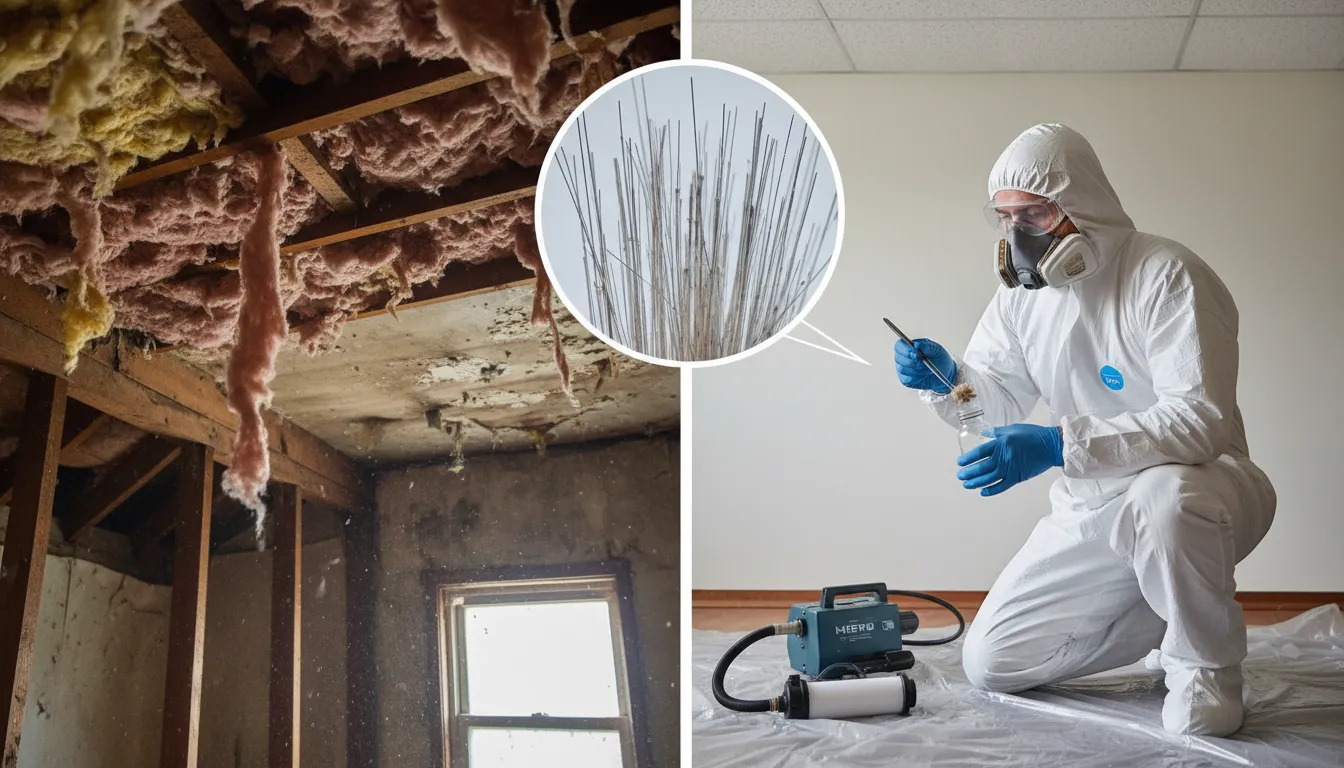
This interview-style guide answers key questions about asbestos. It tells you what it is, where it comes from, why people used it so much, how it can hurt people, and what you should do if you find it in a house, job site, or thing you use. The main goal is to be useful. It helps homeowners and others like trades people, building managers, and safety workers get a clear guide about asbestos danger, testing, handling, and rules.
What is asbestos?
Asbestos is made up of several minerals found in nature. These minerals form long and thin fibers. The fibers are strong, bend easily, and do not get damaged by heat or chemicals. These features made asbestos important to companies for over a hundred years.
To sum up, asbestos is a type of fiber that does not break down from heat or being used over time. You can mix it into other things or weave it to make them strong. It is used to help stop heat and sound from passing through.
How many types of asbestos are there, and what distinguishes them?
There are six main minerals that are often called asbestos. These minerals belong to two mineral groups.
Serpentine family: Chrysotile (white asbestos). Chrysotile fibers are curly and can bend, so it was easy to spin and weave them into cloth and for other types of insulation.
Amphibole family: Crocidolite (blue asbestos), amosite (brown asbestos), tremolite, actinolite, and anthophyllite. Amphibole fibers are straighter and harder. They feel more like needles than chrysotile does.
Each type has a different fiber shape, tensile strength, and chemical strength. These differences changed how makers used them. Amosite and crocidolite, for example, were often used in insulation and cement because they were stiff and could handle heat.
Where and how does asbestos form in nature?
Asbestos minerals come from natural changes deep in the earth. There is heat, pressure, and fluids full of minerals. These changes often happen when the ground moves or rocks are changed. In these places, silicate minerals that look like fibers grow in cracks or veins. Asbestos is mostly found in rocks like serpentinite and other rocks in mountain ranges and old areas where the ground shifts.
You can see veins of asbestos in rocks or open-pit mines. In the past, miners took the fibers out of a vein by hand. Now, people use geological surveys to find where the deposits are. Then, they take out the ore for factories to process.
Why was asbestos used so widely?
The practical things about asbestos show why many use it:
Heat and fire protection: Asbestos stays strong in very high heat. It does not burn or change shape.
Strength and bending ability: These fibers help make cement, plastics, or textiles strong and bendable.
Insulation and quieting: Asbestos keeps heat inside and stops loud sounds.
Chemical and damage protection: Some types stand up to acids and seawater. This made them good for chemical plants and ships.
Price and easy use: In the 19th and 20th centuries, asbestos items were made and used quickly with the tools and methods people had then.
Those things made asbestos easy to find in many places. It was used in boilers, shipbuilding, building supplies, glue, gaskets, brakes, roofing, and to keep wires safe.
What products commonly contain asbestos today and historically?
Many countries stopped or limited the use of asbestos the past few years. But, there are still older buildings and old products that have asbestos. You can find asbestos in some materials like:
Insulation that is on steam pipes, boilers, and furnaces
Asbestos cement sheets and roofing
Floor tiles and adhesive mastics
Textured ceiling coatings and popcorn ceilings
Sprayed or blown-in insulation and fireproofing
Gaskets, packing, and brake linings in vehicles and industrial machines
Electrical wiring insulation and some early appliance cords
Asbestos-containing cement pipe and siding
Some friction products like clutches, brake pads, and clutch facings
Old gloves, pads, and fire blankets that can handle heat
Some newer products that people use might still have asbestos in them as a contaminant. For example, talc-based powders can have small amounts of asbestos minerals. It is good to check the latest guidance and rules before you think something does not have asbestos in it.
How does asbestos exposure lead to disease?
Asbestos-related diseases start when tiny asbestos fibers get into the body. This can happen when people breathe in or swallow the fibers, but breathing in is much more common. The main ways these diseases develop are:
Fiber build-up: Long, thin fibers get deep in the lungs. They can stay in the alveoli and the pleura, which is the membrane around the lungs.
Lasting swelling: The body can't break down these mineral fibers. Ongoing irritation brings swelling and scarring.
Cell harm: Swelling over time raises the risk of DNA damage and can lead to lung tissue and pleural cells turning into cancer.
Important asbestos-related conditions include:
Asbestosis: This is when there is more and more scarring in the lungs. It makes it harder to breathe and lowers how well the lungs work.
Mesothelioma: This is a rare cancer. It happens in the lining of the lung and sometimes the belly. It is strongly tied to being around asbestos.
Lung cancer: Being around asbestos raises the risk for lung cancer. This risk is even higher in smokers.
Pleural disease: There can be thick spots, more thickening, and fluid that builds up in the lining of the lung. These are common signs from being around asbestos that are not cancer.
It can take a long time to see symptoms. You may not notice any signs until 20 to 50 years after you are first around asbestos. There is no level of asbestos that is known to be safe for people.
Which types of asbestos are most dangerous?
All regulated types of asbestos can be bad for your health. Some studies show that amphibole fibers, like crocidolite and amosite, can harm people more for each fiber, compared to chrysotile. The straight and needle-like shape of these fibers, and how tough they are, means they stay in lung tissue for a longer time. Still, breathing in chrysotile also causes sickness. It adds to lung cancer and mesothelioma as well. Rules treat all regulated asbestos types as dangerous.
How do people and workers typically get exposed to asbestos?
Common exposure scenarios include:
Occupational exposure: Shipyard workers, people in construction trades (like insulators, pipe fitters, roofers, electricians), people in factories, and demolition crews have had the highest risk.
Take-home exposure: Family members can get exposure when fibers are brought home on clothing, hair, or tools.
Environmental exposure: People who live near asbestos mines, processing plants, or open asbestos rocks in the area may have risk in their communities.
Consumer product exposure: This happens when people touch old asbestos materials at home or use talc products that have been contaminated.
Renovation and demolition: When asbestos materials are disturbed during repairs or teardown projects, fibers get released if there is no proper control.
How is asbestos identified and tested?
To find out if there is asbestos, you need to send a sample to a lab. People often use these ways to test:
Bulk sampling: A small piece of suspected stuff is taken and checked by polarized light use (PLM) or transmission electron check (TEM). PLM is used for even building things, and TEM can find lower amounts of fibers or test air samples.
Air monitoring: People can take air samples to look for fiber levels. They use phase contrast tools (PCM) or TEM, which can show clear results.
Professional surveys: Trained asbestos experts follow set steps for getting samples, keeping records, and making reports.
Important rule: do not think a thing is asbestos or safe. Do not cut, scrape, sand, or move things that seem unsafe. A test must be done by labs and workers who follow local rules.
What should a homeowner or contractor do if they suspect asbestos during renovation?
A practical step-by-step approach:
Stop work: Stop right away if you are doing anything with the material.
Contain the area: Close doors and keep people out. Do not let dust move to other rooms.
Do not vacuum: A regular vacuum will spread fibers. Do not sweep or dry brush.
Hire an accredited inspector: Get a professional to do an asbestos check and sample.
Follow test results: If tests show the material has asbestos, follow local rules for fixing it—cover it or use a licensed team to remove it.
Retain documentation: Keep lab reports and papers that show the contractor’s skills for your records on the property.
What are common abatement options and how safe are they?
Abatement ways change based on the state of the site, where it is, and how you use it.
Leave in place and manage: If asbestos-containing material is not damaged or disturbed, it's best to let a pro manage it and check on it from time to time. Encapsulation or enclosure will often keep fibers from getting out.
Encapsulation: A special sealant can be used to keep fibers inside the material. This is a way to avoid much disruption.
Removal by licensed professionals: When you need to take out asbestos, licensed workers do it the right way. They use barriers, keep air flowing with negative pressure, use HEPA filters, and handle the waste in the right way. If done correctly, removal will be safe.
Replacement: Sometimes, the old material is taken out and new, non-asbestos material is put in its place.
It is not good to try to take this out by yourself. Taking it out in the wrong way can make a lot of fibers go into the air. This can also give you a bigger risk to your health.
What personal protective equipment and controls protect workers from asbestos?
For regulated work, controls include:
Engineering controls: Local air systems with HEPA filters, setups that keep air pressure lower in work areas, and wet ways to keep dust down.
PPE: Right face masks (like P100 or powered air-purifying face masks) that fit and are approved, single-use or washable coveralls, gloves, and eye gear.
Decontamination: Set up areas to change, showers at the site, and safe throwing out of dirty clothes and waste.
Training and medical surveillance: Workers need to get training about dangers and steps to follow, and they might be part of health checkup plans rules want.
How is asbestos legally regulated?
Rules change from one country to another. In some places, like states or provinces, rules can also be different. Still, you will see some things be the same everywhere:
Workplace standards: Occupational agencies set limits on how much people can be around asbestos. They also decide what controls you need, what training you must have, and when to do health checks.
Building and renovation rules: Many places ask for asbestos checks before you fix or tear down a building. For some materials, they want licensed people to remove the asbestos.
Waste management: Asbestos waste is set into groups and must be thrown away in special landfills. This helps keep fibers from getting in the air.
Product bans and restrictions: Some countries have stopped using asbestos fully. Others only let you use certain types or in some cases.
Always look at your local agency to find the most recent rules for your project or workplace. Make sure you know what rules to follow.
Can asbestos be safely left in place?
Yes—when materials have asbestos, and they are in one piece and not going to be touched, it is best to leave them alone and take care of them. This is a way to keep risk low. Management plans include:
Regular checks to make sure that things can still be seen and will not be harmed
Cover or close up the area if a small fix is needed
Easy-to-read tags and notes, so anyone working later will know that it is still there
Removal should be done if the materials are breaking down. You should also do this if they will be moved because of work on the building, or if they can cause harm.
What common myths about asbestos should people be aware of?
Many common mistakes can make you choose the wrong thing. Here are some important things you should know:
Myth: “Only amphibole asbestos is dangerous.” Reality: All regulated asbestos can cause serious illness. A difference in how strong they are does not mean chrysotile is safe.
Myth: “You can tell asbestos by looking.” Reality: You can not know if something has asbestos just by look at it. A lab test is needed.
Myth: “Small exposures are harmless.” Reality: No one knows what amount is safe. The risk goes up the more you are around it. The effects take a long time to show, so it is hard to see problems early.
Myth: “Encapsulation always solves the problem.” Reality: A cover stops fibers from come out while it stays in good shape. If the cover is damaged, it might not work and needs to be checked.
Myth: “Asbestos in older ceramics or talc is impossible.” Reality: Some talc and vermiculite ores had asbestos inside. A test is needed.
How do medical professionals evaluate asbestos exposure?
Medical evaluation typically includes:
Exposure history: A detailed look at where and how you have worked and lived, with focus on how long, how strong, and when you had contact with asbestos.
Physical exam: A doctor will listen for any strange sounds when you breathe and check how well you can breathe.
Imaging: Chest X-rays and clear CT scans can show if there are any changes, scars, or growths in the lung lining.
Breathing tests: These tests help measure how much air your lungs can hold and how well gas moves in and out.
Specialist referral: A lung doctor or a work health expert will help watch and treat you for a long time.
Early detection of asbestos-related disease can be hard because symptoms don't show up much at first. Most people feel fine until the disease gets worse. If you have been around a lot of asbestos, you should get checked by a doctor on a regular basis.
What immediate steps should someone take after a significant recent asbestos exposure?
For recent or accidental exposures:
Stop exposure: Leave the place right away and do not touch the material again.
Remove dirty clothes carefully: Do not shake your clothes. Put them in a bag for trained people to wash or throw away if rules say so.
Shower and wash skin that got exposed: This step helps stop others from getting exposed, too.
Tell your boss or the person in charge of the building: This helps make sure testing and cleaning is done right.
Get medical help: A doctor can write down what happened, run basic tests, and tell you what to do next.
Write down what happened: Note the date, place, how it happened, the names of others who saw it, and take any photos if you have them.
How is asbestos waste disposed of?
Disposal practices aim to prevent fiber release:
Collect and wet asbestos waste to keep dust down.
Put waste in labeled, strong, sealed containers or heavy-duty bags.
Take waste to a landfill that is allowed to take asbestos waste.
Keep records when your local law says you have to.
Improper disposal, like dumping or burning in the open, is not allowed. It puts people’s health at risk.
Are there international differences in asbestos regulation?
Yes. Some countries have full bans on using and bringing in asbestos. Others block just certain types and how it is used. Rules for how much you can be around it, who can remove it, and how to get rid of it are not the same everywhere. If you work in other countries or deal with things brought in, find out what the laws are in that country. Look at the labels and test results for the product.
How can building owners and managers build an asbestos management plan?
A basic, practical asbestos management framework:
Survey: Have a professional come in to check for asbestos. Make a list of things that might have asbestos in them. Write down the results from samples.
Risk assessment: Look at each item on the list. Rate them by how they look, where they are, and how likely they are to be disturbed.
Control strategy: Decide what to do with each item. You can keep it where it is, cover it up, or take it out. Pay closest attention to places like HVAC spaces, busy areas, and spots where people work on repairs.
Work protocols: Make sure people get permits for any repairs or changes. Always use steps that keep people safe from asbestos. Call licensed contractors when asbestos needs to be removed.
Record keeping: Keep all reports, lab results, contractor details, and records in a place where people living or working there, and the next owners, can get them.
Communication and training: Let staff and contractors know where asbestos is. Teach them how to work safely around it.
Periodic review: Check and update your plan after fixing or testing anything new.
What are practical signs that a material might contain asbestos?
Things you see are not always a sure sign. Still, some signs to look for are:
Materials put in before the 1980s or 1990s in many places
Textured ceilings and popcorn ceilings, mainly in older homes
Insulation around steam pipes, boilers, and things like mechanical gear
Old floor tiles (9x9 inch vinyl or bituminous tiles) and glues used to stick them
Asbestos cement siding or roofing sheets that have a wavy look
Soft white, gray, or brown insulating materials that break apart easily
The only way to be certain is laboratory analysis.
How should contractors bid work when asbestos might be present?
Best ways for contractors to make estimates:
Include a first asbestos check or make room for it if needed.
Make sure that anything that looks unsafe will get checked before people touch or move it.
Give different line entries for removal, getting rid of waste, and testing the air after everything is taken out.
Check what licenses you need and add the costs to follow the rules, like HEPA tools, waste papers, and special safety gear.
Teach workers about asbestos and, if needed, get them medical checks.
What are some notable historical uses or incidents involving asbestos?
Here are some good examples that show how much asbestos was used in work life:
There was a lot of use in shipyards for insulation around boilers and pipes.
Asbestos cement was used for roofing and piping in buildings and water systems.
The use in making things and for maintenance was common until safer synthetic materials could be used.
People in factories got exposed at work. This led to health problems being noticed and later made many countries make rules about it.
Those past ways of doing things show why old asbestos is still found in older buildings. They also show why people who work in building and on ships are some of the most at risk.
What resources should people consult for authoritative guidance on asbestos?
For the most current advice, talk with the official agencies and trusted groups in your area.
National workplace safety and health agencies set rules and limits for work exposure.
Environmental protection agencies help with building repair and waste cleanup.
Local public health departments can help with issues in your community or school.
Certified labs and licensed asbestos removal groups handle testing and getting rid of asbestos.
Professional groups in worker safety, workplace health, and minerals offer expert advice.
Checklist: What to do before starting renovations in older buildings
Here is a quick checklist for the homeowners, building managers, and contractors to go through before starting any renovation:
Check the building age and see if there has ever been work done before.
Order a survey from a pro if you think the place may have asbestos.
Get the lab’s reports and keep them.
Plan your work. This way, you do not mess with asbestos before you know it is safe.
Use workers who are allowed to remove or cover up asbestos.
Set up an air check after the work, and do not go back in until you know it is safe.
Keep all your papers to show people who may own the place next or if someone comes to check the work.
Are there alternatives to asbestos for insulation and reinforcement?
Yes. Today, people use things like mineral wool, ceramic fibers, fiberglass, cellulose, polyurethane foams, and engineered fiber-reinforced cement instead. The choice depends on where you want to use it, what level of heat or fire safety you need, and how long it needs to last. When you need to replace asbestos, be sure to get certified products that do not have asbestos and that work the same way.
How can homeowners lower liability and future risk related to asbestos?
Here are some simple steps you can take now to help keep people safe and avoid problems later:
Get an asbestos survey done and keep records that are easy for buyers or tenants to get.
Mark all materials that have asbestos in the building papers and work schedules.
Tell workers and those fixing things about the presence of asbestos before they start the job.
Follow local rules for telling people and getting permits when doing work to remove asbestos.
Set aside money for skilled work to remove or look after asbestos if things get broken or need to be moved.
What legal or compensation options exist for people with asbestos-related illness?
Legal systems are different in every place. But in many areas, you can still get money if you get sick from the workplace or from products that have asbestos. The ways to get this help might be workers compensation, claims about the product, or going to court because someone did not warn you or did not do the right thing. People who want to get help for asbestos problems need to talk to a lawyer who knows a lot about job-related sickness and asbestos law for advice that fits where they live.
Final takeaways: What should every reader remember about asbestos?
Key points to retain:
Asbestos is a group of dangerous fibers found in some minerals. They were commonly used because they can take heat and are strong.
All types of asbestos that are watched by rules can harm health. There is no level of exposure that is thought to be safe by everybody.
Testing is very important. You cannot be sure a thing is free from asbestos just by looking at it.
Do not touch or move things you think may have asbestos. Bring in professionals who are approved for surveys, cleanup, and removal.
Keep track and handle: Keep notes and take care of stuff with asbestos instead of trying to remove it yourself.
FAQ
What is the difference between chrysotile and amphibole asbestos?
Chrysotile (serpentine) fibers are curly and can bend easily. Amphibole fibers, like amosite, crocidolite, tremolite, actinolite, and anthophyllite, are straight and look like needles. Both types can cause disease, but amphiboles usually stay in the lung tissue for a longer time. There are rules that treat both families as dangerous.
Can I test for asbestos myself?
You should not touch or move anything that looks suspicious. Only trained professionals can take samples. They use the right tools to keep the area safe and to track what happens next. Accredited laboratories do the testing, so you get results you can trust.
Is asbestos still used today?
Some countries still let certain uses of asbestos or allow things with asbestos to be brought in. Other countries stop all asbestos use. Always look at national and local rules to see the current status.
How long after exposure do symptoms appear?
Many people who get diseases from asbestos do not feel sick right away. It can take 20 to 50 years for these problems to show up. Most early signs are hard to notice. It is good for people who have been around a lot of asbestos to see a doctor often.
What should I tell my doctor if I had asbestos exposure?
Give clear details about your exposure. Talk about the dates, how long you worked, your job title, what jobs you did, what things you worked with, and any things you used for safety. Bring lab reports or survey results if you have them. The doctor might ask for imaging and tests to see how your lungs are working.
Does asbestos contamination in talc-based products happen?
Yes. Some places where you find talc are also close to where asbestos comes up from in the earth, and this has led to some talc being found with asbestos. It is a good idea to test talc for asbestos when you have a reason to think there may be contamination.
Is encapsulation a permanent solution?
Encapsulation can be a good long-term way to deal with the asbestos that is in place and out of reach. This needs regular checks and care. If you think it might get disturbed later, taking it out might be a better choice.
Who regulates asbestos abatement and worker safety?
Local and national groups take care of rules. In many places, safety groups watch over workplaces for issues and training. Groups for the environment set rules for fixing up buildings and handling waste. Look up what groups and standards are in your area.
Where can I find a certified asbestos contractor?
Use lists from government groups, industry groups, or trusted certifying groups to find licensed abatement contractors. Check their license, insurance, past work, and paperwork from recent jobs before you hire them.
What do I do if I find suspect asbestos in a rental property?
Let the property manager or landlord know about this in writing. Stop doing anything that may disturb the asbestos. Ask for a professional asbestos survey and removal if the asbestos is damaged or tests show it is there. Tenants have to keep all records of their chats and reports.
How can I protect my family from secondhand asbestos exposure?
If someone in your house works with asbestos, they should change clothes and take a shower before they come home. They should keep work clothes in a different place and get them cleaned by people who know how to handle it. Follow the cleaning steps set by their job. Do not do home repairs that can touch or move things that might have asbestos unless you test those things first.
Is asbestos removal required before selling a house?
Requirements can change from place to place. Some areas ask you to tell if you know about asbestos. They might also need you to clean it up if you are doing some work on the house or trying to get a loan or insurance. Give all disclosures to the buyer. Share survey reports during the transaction.
Can air testing prove a building is safe after abatement?
Clearance air testing is done by a lab that is both independent and approved. This is the main way to check that there is less asbestos fiber in the air after cleanup. The amount in the air must be lower than what the local rules say is allowed. Make sure the way you test and what you accept also follows local rules.
How can I minimize exposure during DIY minor repairs?
Best practice: avoid doing it yourself if you think the materials could have asbestos. If you have to do small work, do not touch or move materials you think could have asbestos. Use wet methods and HEPA filter vacuums when cleaning up. Also, wear the right respirator and disposable coveralls. If you are not sure, call a professional.
Where can I learn more about asbestos disease compensation?
Talk to legal experts who work on workplace illness and product rules. Reach out to workers' compensation boards or national health groups. They can help with advice on benefits and claims. What is offered can change from place to place.
Summary
Asbestos is still a big problem for public health and the environment. This is because it is tough, was used a lot in the past, and it takes many years for health problems to show after someone is exposed to it. The best way for people who own or work on buildings is simple. You should find any materials you think may have asbestos by getting them tested by a professional. Do not touch or move materials if you know they contain asbestos. Always use trained and licensed people to remove or handle it. You must keep records of what you do, follow local rules, and put controls in place to keep people safe—these steps help lower risk for everyone in the building and help keep the building working well and keep its value.
Comments
Post a Comment